
Sunday Sermon - 28th of June
Sermon: Prophets of Peace in Times of War
Readings
Jeremiah 28:5-9
Then the prophet Jeremiah spoke to the prophet Hananiah in the presence of the priests and all the people who were standing in the house of the LORD, and the prophet Jeremiah said, "Amen! May the LORD do so; may the LORD fulfil the words that you have prophesied and bring back to this place from Babylon the vessels of the house of the LORD and all the exiles. But listen now to this word that I speak in your hearing and in the hearing of all the people. The prophets who preceded you and me from ancient times prophesied war, famine, and pestilence against many countries and great kingdoms. As for the prophet who prophesies peace, when the word of that prophet comes true, then it will be known that the LORD has truly sent the prophet."
Matthew 10:40-42
"Whoever welcomes you welcomes me, and whoever welcomes me welcomes the one who sent me. Whoever welcomes a prophet in the name of a prophet will receive a prophet's reward, and whoever welcomes a righteous person in the name of a righteous person will receive the reward of the righteous, and whoever gives even a cup of cold water to one of these little ones in the name of a disciple -- truly I tell you, none of these will lose their reward."
Sermon
Once upon a time a man got up and proclaimed a message of peace. But this was of a peace brought about through war. He promised that if people were to fight then all the people currently oppressed by the nation he wanted to attack would be freed. Not only that but it would bring about immense prosperity, solidifying their own nations power on the global stage. In the process they would bring down the corrupt regime in place in the country he wanted to attack. And to sweeten the deal it would all be over very quickly and anyone who questioned him was dismissed as fake news. He thought it was the perfect time to attack because there had been protests in the country and he saw it as a moment of weakness during which he could strike his enemy and win. Surely if they attacked now there was no possibility of their opponent being able to put up a fight.
But then a prophet posted a tweet criticising Trump’s war against Iran as foolish and a threat to global peace. Wait sorry let me check my notes. I meant to say that Jeremiah stood up and confronted Hananiah for his foolish prophesies and false promises of peace.
Let’s rewind a wee bit. In 597BCE King Nebuchadnezzar of Babylon takes control of a little bit of land that was known at the time as the Kingdom of Judah, modern day Palestine. The Babylonians take all the treasures from the temple in Jerusalem, they take government officials, mighty warriors, and over 10000 captives, predominantly workers and artists only leaving behind the poorest of the poor. (2 Kings 24) Because they had taken the King, Nebuchadnezzar wanted to put someone in charge of the territory who he would have power over. So he puts a 21-year-old on the throne and gives him a new name. Zedekiah.
At the start of Zedekiah’s reign this guy named Jeremiah comes along. Jeremiah is known as the weeping prophet because he doesn’t usually have very fun things to say in the midst of all this political instability. Our reading today brings us to the year 594 BCE, in the fifth month of the fourth year of King Zedekiah’s reign to be exact and the Babylonian army had experienced a revolt within its ranks. A man named Hananiah sees this and has had enough of Jeremiah’s message of doom and gloom and instead encourages the people of Judah to go to war with Babylon and try and break free from the rule of Nebuchadnezzar. He says that within two years Jerusalem will be returned to its former glory and all the people that were taken will be brought home.
Jeremiah gets up and sounding a bit tired and sarcastic says. Amen, May the Lord do so. You can almost hear the tone in his voice like yeh right, sure, I’ll believe it when I see it. Which is basically what he says. In verse 9 of our reading Jeremiah says, “As for the prophet who prophesies peace, when the word of that prophet comes true, then it will be known that the Lord has truly sent the prophet”.
Now King Zedekiah sides with Jeremiah on this occasion mainly because Hananiah dies suddenly 2 months after his prophecy of peace. But eventually in King Zedekiah’s ninth year as king he does rebel against Babylon and King Nebuchadnezzar comes down on him hard. The Babylonians lay siege to Jerusalem and the war lasts almost 2 years. The inhabitants of Jerusalem are starving because they have ran out of food, the Babylonians eventually breach the walls and after capturing Zedekiah they enter the city and burn down the temple, the place that ancient Judah and Israel believed the shekinah or divine presence resided on earth.
So what do we do with this passage today. Do we say that we should not speak a word of peace, no I don’t think that is what Jeremiah is getting at here. He highlights that he and the prophets before him have prophesied war, famine, and disease but they were right. Jeremiah and the Hebrew prophets before him prophesied not simply as a truth telling function but often as a warning. Reading the signs of the time they offered a word of challenge to the people, speaking truth to those in power, saying if we don’t change our ways then disaster lies before us.
Jeremiah doesn’t come across in today’s passage as necessarily wanting to prophecy this destruction and war. In fact he says in the chapter before that the ancient Kingdom should accept its fate for the time being so as to prevent their people dying by the sword, by famine, or by disease. (Jeremiah 27:13)
The line in this passage that stood out to me was where Jeremiah describes “prophets who prophesy peace”. And it made me think who is the real prophet of peace in this passage? Is it Jeremiah with his doom, gloom, and realism about what war would cause. Or is it Hananiah who insists that peace will come if they would only rise up and go to war.
It seems to me from this passage that it doesn’t matter how much we talk about peace, sing Kumbaya, or insist that this one war will bring about peace in the long run if the end result is death, displacement, and destruction. Jeremiah appears to be the true prophet of peace here warning of the dangers inherent to warfare, that it’s much easier to start one than it is to end one.
Historically, the idea that has been used to justify Christian participation in and support of warfare is called just war theory. St Augustine was a big influence on this idea. Today just war theory is often pointed to by politicians who are waging wars that are anything but just. This year US vice president JD Vance pointed to this theory to justify the US war on Iran, and he warned Pope Leo that he should “be careful when he talks about matters of theology ... you've got to make sure it's anchored in the truth”.
This is despite the fact that Pope Leo is himself an Augustinian and almost certainly more qualified to speak on theology than Vance. Because just war theory actually has quite strict limitations on when war is appropriate. It has to be waged by a legitimate authority not by individuals. It has to have a just cause, namely that it is a response to injustice and not simply aggression or a land grab. The ultimate goal must always be peace, and it must be proportionate, non-combatants should be protected, and mercy should be prioritised. And war is not something to celebrate it is to be mourned.
St Augustine put it like this "Anyone who feels joy at even a just war has lost touch with their humanity." But since the end of the second world war and seeing the use of nuclear weapons at Hiroshima and Nagasaki the thinking of just war theorists has shifted towards a recognition that the theory itself has become outdated.
George MacLeod, founder of the Iona Community, former Church of Scotland moderator, and campaigner for nuclear disarmament said in a pamphlet in the 1960s that there is no conceivable just war, there is just bloody war, our age is on the lip of having to admit that the centric witness of the Church has to be absolute opposition.
Just a couple of months ago Pope Leo in his encyclical Magnifica Humanitas acknowledged that the idea of just war is often used to justify any war and that the idea itself is outdated in our age of nuclear weapons, drones, and AI powered warfare.
But we live in a world where countries are increasing military spending, just two weeks ago Finland lifted its ban on nuclear weapons, and it feels as if we are now in an age of strongmen who seek to take what they want by force all the while trying to portray themselves as the peaceful or just ones.
In our gospel reading today Jesus is speaking to the twelve disciples and before the verses we read, he sends them out to proclaim the good news that the Kingdom of heaven has come near and with it comes deliverance and healing. But he warns that he is sending them out like sheep among wolves, that they will face ridicule and persecution, but to not fear those who can kill the body, and he says this line which seems out of place. “Do not think that I have come to bring peace to the earth, I have not come to bring peace, but a sword”.
This is not a contradiction of Jesus’ other sayings on peace-making, turning the other cheek, and his warning that those who live by the sword die by the sword. Rather it is acknowledging something that was common in rabbinic writing of the time that there would be pain and suffering before the messianic age of peace would be established.
After saying all this we come to the words we heard today. Whoever welcomes you, welcomes me. Whoever receives a prophet in the name of a prophet will receive a prophet’s reward. Whoever gives even a cup of cold water to one of these little ones will not lose their reward.
In a world where followers of Jesus are called to proclaim the good news of God’s kingdom of justice, peace, and joy in the Holy spirit that brings with it healing and deliverance. They will face opposition, and they will have to choose to pick up their cross. In this world anyone who welcomes this good news and those who bring it will be rewarded, Jesus says.
In another gospel reading the disciples enter a village and unlike the people Jesus talks about in today’s passage this village does not welcome them, they do not receive a prophet in the name of a prophet. Two of the disciples James and John respond saying “Lord, do you want us to command fire to come down from heaven and consume them”. But Jesus turns and rebukes them. (Luke 9:55-56)
In fact if you turn your attention up here for a minute and look at this window. On the right we have James and John, one of them pointing up as if to say should we command fire to come down. Jesus on the left, eyebrows slightly furrowed, with his hand open and facing down. And beneath James and John the words the son of man has not come to destroy men’s lives but to save them. Just take a moment and look for a while at that image.
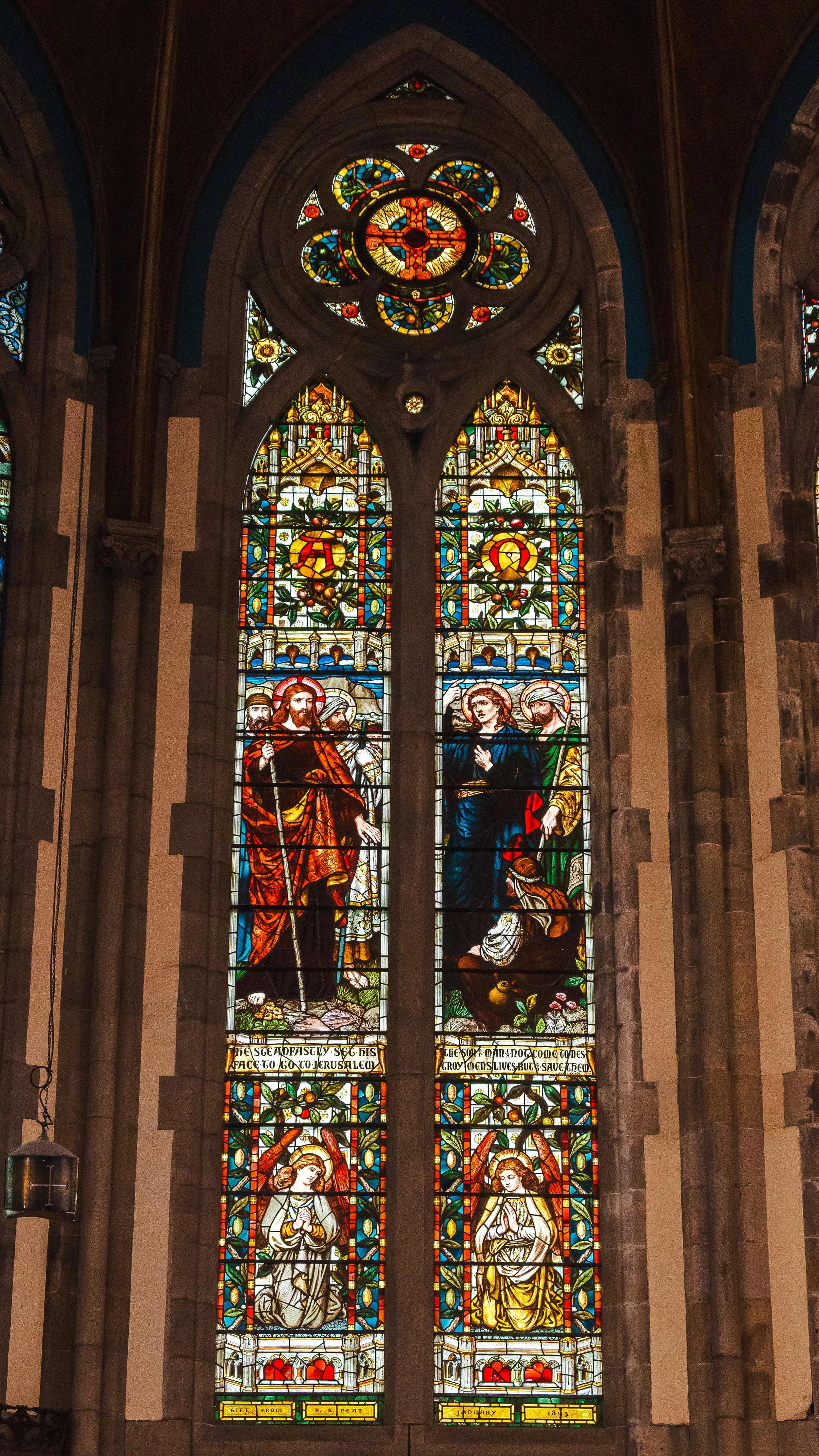
You might think that James and John seem completely unreasonable here. I wonder though if we see ourselves in them. How do we respond when people reject us? Do we become defensive maybe even aggressive. How do we engage with those we disagree with? Do we put up a wall and start to draw neat dividing lines between us and them? How do we react when we get into an argument with a loved one or friend? Do we slow the conversation down and stop or do we respond out of frustration and anger and say something that we later regret.
Scripture tells us that in Christ we are reconciled to God and have been given the ministry of reconciliation. That is the ministry of restoring relationships after they have broken down, of ending hostilities to reach a place of agreement and even friendship. We are described as acting as Christ’s ambassadors as if God was making his appeal through us (2 Corinthians 5). That all things in all of creation are being reconciled to God who made peace through the blood of the cross.
During the blitz Coventry cathedral was bombed and the roof collapsed in the aftermath two of the roofbeams were found charred and in the shape of a cross. It was put up behind the altar and the priest there wrote on the wall simply saying father forgive. Not father forgive them, just father forgive. Because during war all are guilty.
A group in Coventry would go on to establish the community of the cross of nails whose symbol has one metal nail standing vertically representing the fact that our reconciliation to God is God’s work and God’s alone, it is a pure gift. And then it has two horizontal nails representing our relationships with one another, demonstrating that the work of reconciliation is something that we all must work for.
This is not easy work. Jesus calls the peacemakers not the peacekeepers blessed. It is not those who agree to ceasefire that are blessed it is those who negotiate for and achieve justice and reconciliation. It is those engaged in the hard work of mending broken relationships, righting wrongs, and choosing not to lean into our tendency to try and call down fire from heaven on our enemies.
This might mean that we need to be a bit more like Jeremiah and less like Hananiah. To be weeping prophets, who mourn the consequences of war and conflict, doing all we can to avoid it, and still speaking truth to those in power who will go to war and justify it after it has already started. Speaking difficult but true words, engaging in the necessary work of reconciliation, and proclaiming the good news that the Kingdom of God has come near. To be sheep among wolves and hope that someone may offer us a glass of water along the way.
Amen.
I want to suggest some ways we might put what we have spoken about today in to practice:
1. As ministers of reconciliation our work for justice and peace flows out of the fact that we have been made right with God. One of the outward signs of this inward change is baptism. So if you are new to faith or have been coming for a while and want to be baptised, we will be having a service for new members to join and the opportunity to be baptised in the next few weeks. If you are not ready to make that decision yet Lance who was preaching last week will be leading a course in September on membership and baptism. Email Doug Gay for more information (douggay@mac.com).
2. Have a look online at some organisations working for peace such as the fellowship of reconciliation, the Christian campaign for nuclear disarmament, or the community of the cross of nails and make use of their resources or consider getting involved.
3. Each day this week take some time to pray over the different conflicts occurring around the world. Pray for justice and peace and for peacemakers to be empowered and strengthened in their work.